
Imaginative Depletion
Has your imagination for what God can do and how things can change become so small as to be almost non-existent? You aren't alone, friend.

I opened the news this week and felt the familiar tightening in my chest. Another conflict. Another tragedy. Another reminder that the world does not seem to be mending as quickly (or at all!) as we once hoped.
Sure, I can believe things will change, but I honestly don’t know the process of getting there. My mind, it seems, has collapsed into a bounded set of things that can happen, none seeming that probable.
I’ve asked myself, “Is this exhaustion? Disillusionment?”
No. No. I don’t think so.
I have not stopped believing God can change things. I don’t think I’ve consciously rejected hope, either.
I don’t doubt the resurrection as a doctrine.
No, what I think is happening is that I am having trouble imagining how things will actually change. I think I want to call this imaginative depletion.
The headlines are moving so quickly and promises never seem to hold. Every day brings another reason to brace myself.
And somewhere along the way, without our noticing it, my inner landscape has begun to narrow — possibility has contracted. My expectations of good overcoming evil and right beating wrong seem to have lessened, not because I am faithless, but because I am tired!
Do you sometimes feel this way today?

Let me explain what I am thinking with imaginative depletion. It is not the loss of faith; instead, it is the shrinking of what we believe faith can do. It is what happens when we still say the creeds but struggle to picture dry bones rising, enemies reconciling, systems reforming, or hearts softening. It is what settles in when we assume that tomorrow will mostly look like today, only slightly more frayed around the edges.
And this seems especially hard during this season of Lent. (Two years ago, I wrote a post during Lent on the color purple. I invite you to read it.)
The Narrowing of the Mind
In Romans 12:2, Paul writes,
“Do not be conformed to this world, but be transformed by the renewing of your mind.”
The word he uses for mind is the Greek nous, which carries far more weight than mere intellect. The nous is the faculty of perception, the moral imagination, the way we see and interpret reality itself. And the word for renewal, anakainōsis, does not mean a minor adjustment or a quick refresh; it means a making-new-again, a re-creation!
Paul assumes that our perception is being shaped, and not always gently, by “this age.” We absorb its anxieties, its outrage, its cynicism, and its limits. We begin to see the world through the lens handed to us by our moment in history, and without meaning to, we inherit its imagination. It’s non-existent imagination.
If the age expects decay, we expect decay. If the age anticipates division, we anticipate division. If the age quietly whispers that nothing really changes, we begin to live as though that is true.
Imaginative depletion, then, is not primarily a spiritual failure; it is a formation issue. We are being formed daily by forces that constrict our sense of what is possible. And unless there is some counter-formation — some renewal of the nous — we will continue to see only what the age tells us can be seen.
When Resurrection Becomes Thinkable
Let me talk for a minute about the Road to Emmaus.
In Luke 24, two disciples walk away from Jerusalem after the crucifixion, their hopes unraveling with each passing moment. When the risen Christ joins them, though they do not yet recognize him, they say this very sad thing:
“We had hoped that he was the one to redeem Israel.”
In Greek, the phrase “we had hoped” is ēlpizomen, an imperfect tense that suggests ongoing hope that has now stalled. It is not that they never believed. It is that their belief has run up against reality as they understood it.
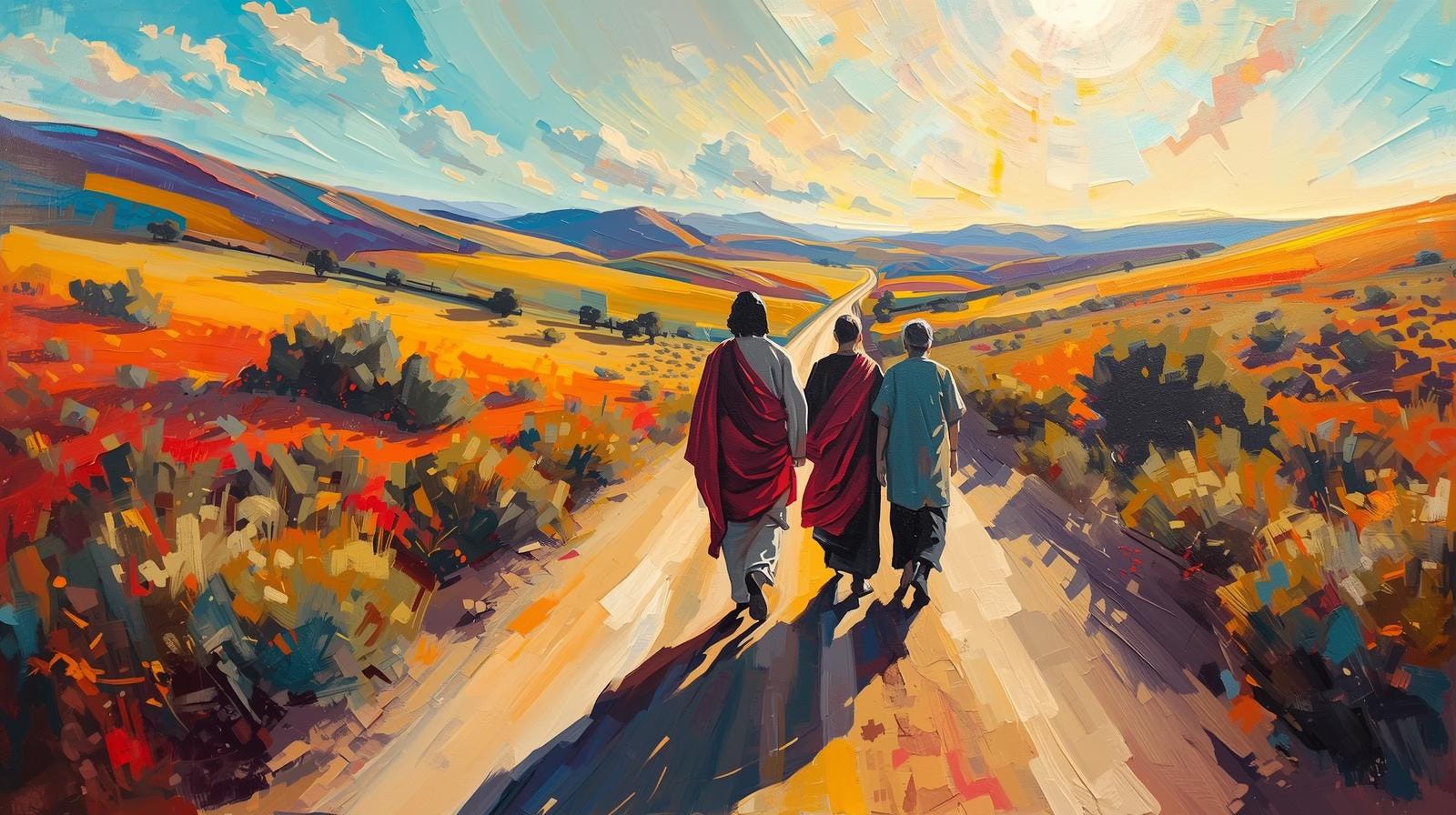
They had imagined a certain kind of redemption, and the cross did not fit within that imagination. Their categories were too small for resurrection.
Notice what Jesus does not do. He doesn’t scold them for unbelief or shame their disappointment. Instead, he walks with them and reinterprets their story. He expands their framework and opens the Scriptures and stretches their understanding until resurrection becomes thinkable.
Sometimes despair is not the absence of faith; it is the limitation of imagination.
The disciples’ grief and confusion were real, but their imagination of what God could do was incomplete. And so Jesus patiently renews their nous, reshaping the way they perceive both suffering and glory.
I wonder whether some of us are not in a similar place. I am.
We have seen enough fracture and failure that our expectations have quietly adjusted downward. We still believe in God, but maybe we do not expect much interruption. We still affirm resurrection, but as a distant theological claim rather than an active force pressing against the present. I find myself returning to history’s hardest questions, for instance — moments like the Holocaust — and wondering how resurrection language survives such horror.
This is where I am currently at with believing in the power of resurrection — of God doing new things and incredible things and things seemed unimaginable and impossible. I wobble.
But what if resurrection were as real as the deepest structure of reality? What if we can hold the stubborn insistence that death does not get the last word, that decay is not ultimate, and that what looks finished may yet stand again?
It’s Lent, after all.
The early Christians proclaimed a crucified Messiah as Lord in the shadow of Caesar’s empire, and they did so without armies, without political leverage, and without cultural dominance. They imagined Jew and Gentile at one table, slaves and masters calling one another brother and sister. They imagined a kingdom not secured by violence, but by self-giving love. This was not naïveté; it was resurrection-shaped imagination in a world that had every reason to expect more of the same.
Centuries later, enslaved African American Christians sang spirituals that dared to envision dry bones rising and Pharaoh’s grip loosening even while chains still clinked around their wrists. “Go down, Moses,” they sang, not because they denied their suffering, but because they refused to believe it was ultimate. Their songs were not escapism, not at all! They were theological acts of defiance, imaginative resistance grounded in the conviction that God’s future was larger than their present.
Dietrich Bonhoeffer wrote of costly grace from a prison cell, and Jürgen Moltmann’s Theology of Hope emerged from the rubble of a prisoner-of-war camp. These were not men insulated from devastation; they were men who stared devastation in the face and still insisted that hope was not foolish. Hope was, in fact, a way of seeing.
None of these examples deny reality. They do not pretend suffering is small or injustice insignificant. What they refuse is the assumption that what is visible is all there is.
Paul’s language in 2 Corinthians speaks of fixing our eyes not on what is seen but on what is unseen. But even without turning there explicitly, the pattern is clear throughout Scripture: faith trains perception. Resurrection stretches imagination.
Lent, then, may not be primarily about subtraction — about what we give up — but about expansion. It may be an invitation to loosen the grip of the age on our nous and allow God to widen our field of vision. It may be a season in which we admit that our imagination has grown cramped and ask for it to be renewed.
Years ago, when I was in a job I could barely tolerate, a friend gave me image. It was one of me in a box, bent over and closed in. “Laurie,” she told me, “God showed me an image of you finding a door and walking through. There you could breathe in the sunlight and stretch to your full height.”
It made me cry.
I think of that now. How many of us are stuck in small, dark boxes of imaginative depletion that have walls plastered with words like “Things won’t change!” and “Just endure!”
Imaginative depletion tells us that nothing truly changes, that systems calcify permanently, that people rarely soften, that division is inevitable, and that decay is the final trajectory of all things.
Resurrection counters with a different claim that sounds almost unreasonable: that the tomb can be empty, that the stone can be rolled away, and that what was buried can stand again.
So what if resurrection were real enough to interrupt our assumptions and to make reconciliation conceivable, justice imaginable, endurance meaningful, and our small acts of faithfulness part of a much larger story unfolding beneath the surface?
I confess I am in a season where I am finding my faith again by believing that resurrection really is real. Despair and death do not have the final word, even when they appear to. And neither should imaginative depletion be allowed a seat at the table.
Jesus walked that road to Emmaus when his disciples believed hope itself had been buried. He was there long before they recognized him.
Perhaps resurrection does not wait for us to muster belief. Perhaps it is already unfolding, even now, quietly widening what we thought was possible.
And perhaps Lent is simply the season in which we learn to see it again. Join me in looking for it?
💜 Much love to you,
Laurie