
Noli Timere: What “Do Not Be Afraid” Really Means in a Fearful World
On "Fear over Faith," Noli timere, and burning ships.

Above my daughter’s bed hangs a very large cloth sign that reads “Faith Over Fear” in black and white. It’s hard to miss. It’s very large.
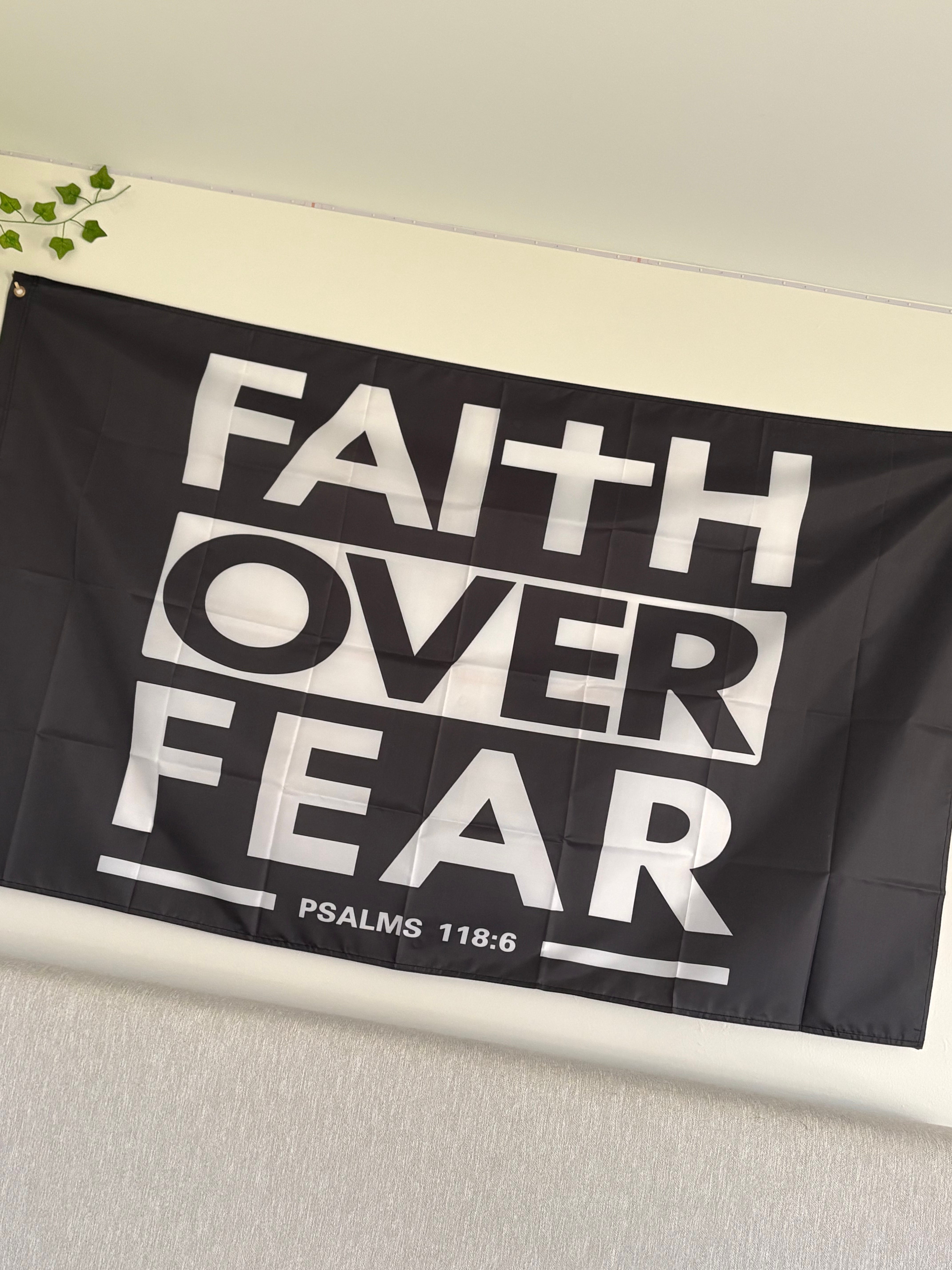
I typically glance over it, but the other day I found myself stopping to just stare at it. I considered that it might in fact be a better wall message than my own small picture of Jiminy Cricket that hangs by my own bed (though he has his merits, which you can read about here!)
Perhaps I stopped on this one day to consider the phrase because the world has felt so dark and depressing lately. The news is just the pits to read these days. Fear has taken a front seat as we journey on our roads of life. Fear, fear, without and within. Fear of the present and the future.
So I sat in my daughter’s doorway and wondered about what it means to have faith over fear.
The Words Christians Have Whispered for Centuries
Christians, of course, have been asking some version of this question for a very long time.
In fact, one of the most repeated commands in Scripture is not “believe,” or “repent,” or even “love” (though all of those certainly appear often enough). Instead, the words that echo again and again throughout the biblical story are surprisingly simple: Do not be afraid.
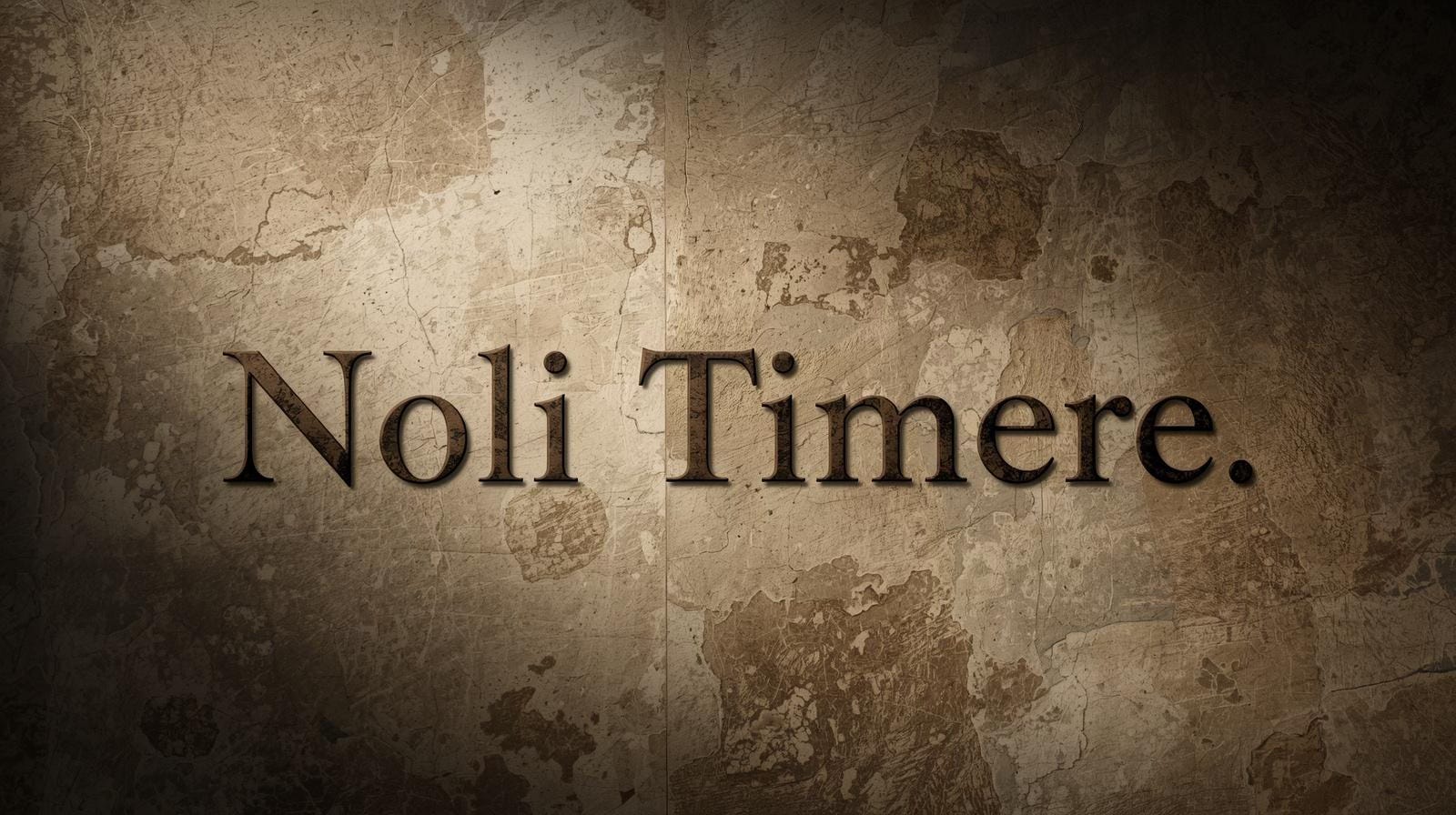
In Latin, the phrase is often translated noli timere. I first came across this phrase while reading a Louise Penny novel and was led into researching more of the epistemology of it. (If you want to know more about noli timere beyond this post, you can read this reflection I did on the term.)
The Greek New Testament uses the phrase μὴ φοβοῦ (mē phobou), literally meaning “stop being afraid” or “do not continue in fear.” In the Hebrew Scriptures, the command often appears as אַל־תִּירָא (al-tira), again carrying that same gentle but insistent invitation: do not give fear the authority to shape what comes next.
What is striking about this command is not just how often it appears, but when it appears.
It rarely arrives when circumstances are calm.
Instead, it almost always shows up when fear would make perfect sense.
One of the most beautiful examples occurs in the Gospel of Luke when an angel appears to a young woman named Mary. The moment itself is already disorienting enough. An unexpected visitor comes with a message that will overturn the entire trajectory of her life. But before this messenger does that, his first words spoken to her are not instructions or explanations.
They are reassurance.
“Do not be afraid, Mary.”
In Greek, again: mē phobou.
It is a strange way to begin a conversation that will include news about an impossible pregnancy, social misunderstanding, and a future she cannot yet see clearly. Nothing about the situation Mary is stepping into will be simple or predictable. And yet the first thing she hears is not a guarantee that everything will be easy.
It is simply this: Do not let fear rule your response.
A similar moment unfolds later in the Gospels when Jesus’ friends find themselves caught in a storm on the Sea of Galilee. The wind rises, the water churns, and in the darkness they see what they think might be a ghost approaching across the waves.
And then they hear a familiar voice saying something remarkably simple:
“Take heart. It is I. Do not be afraid.”
The storm does not immediately vanish and the waves do not instantly calm. What changes first is not the weather; it’s the recognition that Christ is somehow present in the middle of it.
Early Christians seemed to understand something about this dynamic that we sometimes overlook.
If you wander through the ancient catacombs beneath Rome — the underground burial chambers where Christians laid their dead during the early centuries of the Church — you occasionally encounter words carved quietly into the stone. Among the symbols of fish and anchors and crosses, there are phrases meant to be read by those passing through those dim corridors.
One of those phrases appears again and again.
Noli timere.
Do not be afraid.
Which is a remarkable thing to write in a place dedicated to burial!
These were communities who knew grief intimately. They lived in an era when disease was common, life expectancy was short, and persecution was an ever-present possibility. And yet, in spaces marked by loss and mortality, they continued to carve those words into stone as if to say that fear, however real it might feel in the moment, was not the force that ultimately governed the story they believed they were living inside.
When Fear Keeps the Escape Routes Open
I was thinking about all of this recently when I stumbled across a story from history that, at first glance, seems to have nothing to do with Lent or the Bible, and yet somehow feels strangely connected. (If you’ve read this blog for any length of time, you know I am always stumbling on interesting facts. I write them in part here because I will forget them later!)
In 1519, the Spanish explorer Hernán Cortés arrived on the coast of Mexico with a group of soldiers preparing to march inland toward the powerful Aztec Empire. The expedition was dangerous, the terrain was unfamiliar, and the outcome was far from certain. Before long, some of the men began talking quietly about the possibility of returning to the ships.
Cortés responded with a decision that has become famous over the centuries.
He ordered the ships destroyed. “Burn the ships.”
Popular history often says he burned them, though historians believe he actually scuttled them — deliberately sinking the vessels by dismantling parts of them and puncturing the hulls. Either way, the effect was the same. Once the ships were gone, the possibility of retreat disappeared.
The only direction left was forward.
What fascinates me about that moment is not so much the military drama as the psychology behind it.
Fear almost always keeps an escape route nearby.
It whispers that we can move forward as long as we maintain the option to turn around if things become uncomfortable. It prefers contingency plans and backup strategies. Fear likes knowing that the ships are still anchored safely at the shoreline.
And yet there are moments — historically, spiritually, and personally — when the only way into the future is to remove the path behind us.
When the ships sink, you discover very quickly what direction you are actually prepared to travel.
Lent, in its own quiet way, feels a little like that.
The season does not invite us to pretend the world is peaceful when it clearly is not. Instead, it slows us down long enough to acknowledge the fragility of our lives and the brokenness of the world we inhabit. It leads us deliberately toward the cross, where the Christian story confronts suffering, injustice, and death without attempting to soften any of them.
And yet, even here, perhaps especially here, the ancient words continue to echo.
Noli timere.
Do not be afraid.
We say this and believe this not because the world has suddenly become calm, but because the presence of God has entered the story in a way that refuses to allow fear the final word.
Standing in my daughter’s doorway that morning, I realized that the little sign above her bed might not mean what I once assumed it meant.
Faith over fear does not suggest that fear disappears once belief arrives. Fear still whispers through the news headlines and the uncertainties of the future. It still attempts to persuade us that anxiety is the most reasonable posture a person can adopt in a complicated world (check out my post from last week on this all-too-common reality).
But perhaps faith does something more stubborn. Despite everything we see around us, our faith in Jesus asks us to begin to quietly burn the ships that overflow with fear and keep us from fully trusting God as we ought.
Imagine if you were to burn your ships of fear. Imagine if every ship that holds a new fear were gone.
How would you live?
How would you love?
And what would you do differently?
When I imagine burning my ships of fear, I’m not left with nothing. In their place, I see a wonderfully beautiful ship rising from the ashes with good things I could have never seen had I left the other ships in the way.
It feels a bit like resurrection to me.
💜 Much love,
Laurie
I find with the uncertainty of our country at this
time fear is a constant. How to live in this 24/7 ?